PRACTICAL NOTES / BAKHTAWAR KHAN
Define the workflow before choosing AI
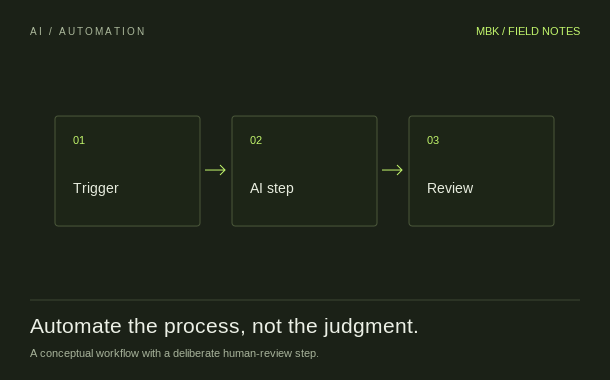
Choose one repetitive task and map its current steps. Define what triggers the workflow, which data it may access, what output is expected and how a person will know whether it worked. If the task is not clear enough to explain as a checklist, automation will probably make the confusion faster.
Make review and escalation explicit
Start with a narrow prototype using non-sensitive sample data. Set expectations for output format, validate required fields and handle missing or contradictory information. Plan for API failures, model uncertainty, retries and duplicate events. Keep credentials in secure server-side configuration.
Protect inputs and evaluate failures
Use human review for consequential actions, external messages, financial decisions or changes that are hard to reverse. Add logs that help diagnose failures while minimizing personal data. A workflow should have a safe stop path and a way to undo or correct mistakes.
Evaluate the workflow against a small set of realistic examples before expanding it. Record where it succeeds, where it fails and which cases require a person. Do not promise perfect accuracy or full autonomy.
Further reading: Official documentation ↗