MBK Global · Practical guide
Map the task first
Describe the input, expected output, owner, success criteria and failure path before selecting tools. Automate repetitive, bounded work before tasks involving sensitive data or high-impact decisions.
Validate inputs and outputs
Check required fields, data types, allowed ranges and external response shapes. Treat model-generated text and third-party API responses as untrusted until validated. Handle missing fields and service failures explicitly.
Protect secrets and personal data
Keep API keys out of public source files and client-side JavaScript when they grant privileged access. Use environment secrets on the server or hosting platform, limit permissions and rotate exposed credentials. Send only the data a workflow needs.
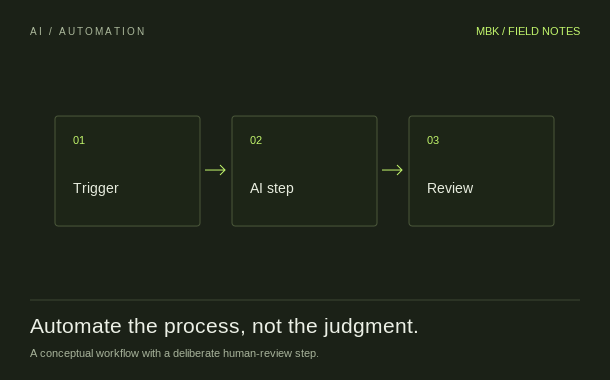
Design for failure and review
Plan for timeouts, rate limits, retries, duplicate requests and partial completion. Log enough to diagnose problems without recording secrets. Require human approval for external actions that are difficult to reverse.
Monitor and document changes
Record what the automation does, its dependencies, limitations and owner. Test edge cases after changes and provide a safe way to pause or roll back the workflow. Never describe an AI-assisted result as verified until it has actually been checked.
About this guide: This is general educational guidance. Adapt recommendations to your site's actual stack, risk and audience, and verify changes before publishing.
Explore related work: web development, projects, and contact.