PRACTICAL NOTES / BAKHTAWAR KHAN
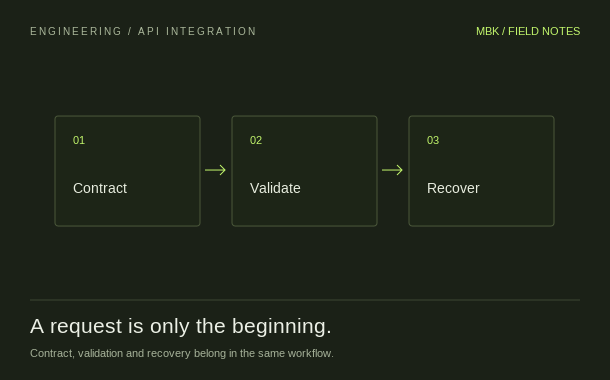
Read the contract before writing code
Before integrating an API, read its documentation and identify the required method, endpoint, authentication, request fields, response shape, rate limits and error codes. Confirm whether the provider permits browser-side requests and what its CORS policy allows.
Design for failure, not only successful JSON
Treat network responses as untrusted input. Handle timeouts, offline states, invalid JSON, rate limits and server errors. Validate required fields before using them in the interface, and show users a clear message when something fails rather than leaving a spinner running forever.
Keep private credentials off the client
Do not put private API keys or long-lived secrets in browser JavaScript or public repositories. If a secret is required, use a server-side function or backend, apply least privilege and store the secret in environment variables. Avoid logging tokens or personal data.
Test the handover as well as the request
Test the happy path and failure paths with sample inputs. Document any dependency on an external API, because availability, pricing and response formats can change.
Further reading: Official documentation ↗
A small release checklist you can actually test
Write the expected behavior for each state before connecting the interface. For an empty result, show an honest empty state rather than an error. For a failed request, preserve the user’s input and offer a safe retry. For a 429 response, respect the provider’s retry guidance; repeatedly retrying immediately can make the limit worse.
- Contract: record the endpoint, method, required fields and authentication model from current provider documentation.
- Boundaries: reject missing or incorrectly typed fields before they reach display or calculation code.
- Cancellation: cancel obsolete requests when the user changes the query or leaves the view, and do not present cancellation as a server failure.
- Privacy: avoid putting tokens, customer information or full private responses in logs and screenshots.
- Handover: document rate limits, credentials ownership, provider costs and what happens when the upstream service is unavailable.
What should be verified before release?
Exercise a normal response, an empty response, invalid JSON, a missing required field, an authentication failure, a rate limit and a timeout. Check that the loading indicator stops in every path and that error text can be understood without opening developer tools. Test with keyboard navigation and a slow connection as well as a desktop connection.
This checklist is general engineering guidance, not a claim that a particular provider integration has been built or certified by the author. For a React-specific companion, read designing interfaces around real API states. For a scoped implementation enquiry, review AI and API integration services.
Reference: MDN: using the Fetch API.