Write the problem before the feature list
“We need a modern website” is a direction, not a brief. Write down who the website serves, what they need to find, and the action you want them to complete. A small service business might need visitors to understand three services and send an enquiry. A product catalogue may need reliable filtering, clear stock information and a supported checkout.
List what already exists: a domain, content, photographs, analytics, customer records and any tools the site must connect to. Mark the non-negotiables and the things that can wait. A developer can estimate a defined journey more responsibly than a collection of design references.
Ask for evidence, not just a screenshot
A polished project image does not explain how a developer works. Ask them to walk through a relevant project: what problem it addressed, what they personally implemented, what depended on another provider, and what they would improve.
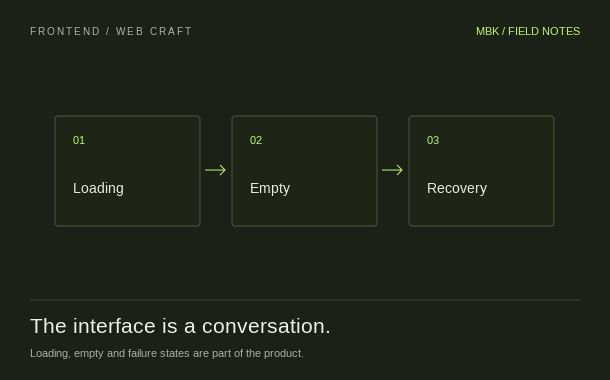
Look at the experience on your own phone. Can you find the main action? Does navigation work with a keyboard? Are empty states and error messages understandable? An independent project can demonstrate judgment, but it should not be presented as a paid client engagement if it was not one.
The project directory and its linked notes are a starting point for that conversation, not a substitute for checking the relevant details.
Compare the whole scope, not the headline price
Two quotes can describe very different work. Ask each developer to identify the pages, features, content responsibilities, revision rounds, integrations, testing and handover included. Clarify whether writing, image licensing, migration and redirects are covered.
- Separate development fees from hosting, domains and recurring software subscriptions.
- Ask what happens when an integration provider changes a policy or charges more.
- Agree how additional requests are estimated and approved.
- Define acceptance criteria: for example, an enquiry form validates required fields and provides a usable failure state.
A smaller, well-defined first release can be a better decision than a long feature list that no one has budgeted to maintain.
Keep ownership and access clear
Your business should know who owns the domain, hosting account, source code, content and paid service subscriptions. Discuss the licenses for any templates, photographs or fonts. Ask what files, documentation and access you receive at handover.
Use delegated access where available rather than sharing a primary password. Never send API secrets or customer data in an initial enquiry. If personal information is involved, agree who can access it, where it goes, how long it is retained and what must be deleted after the engagement.
Agree what happens after launch
Publishing is a milestone, not the end of a website’s responsibilities. Agree on defect handling, maintenance, backups where applicable, provider renewals and who updates the content. Distinguish fixes to agreed deliverables from new functionality.
Ask how launch checks will cover forms, redirects, mobile layouts, indexability and the live domain. No responsible developer can guarantee search positions or eliminate every possible security risk. They can explain the checks they perform, their limitations and how outstanding issues are recorded.
Make the first conversation useful
Bring a short brief, relevant references, a realistic timing range and a budget range if you have one. Ask which uncertainties need research before a fixed proposal is sensible. A useful conversation should leave you clearer about the problem—even if the right answer is a smaller scope or a different platform.
Explore the working process for a stage-by-stage example, compare service scopes, or share your project brief. Availability, price and deliverables are confirmed directly, not implied by this guide.